In 1930, following the abolition of the Bradford Poor Law Union, the Bradford Corporation took over responsibility for the administration of poor relief in the city. This included the children's homes previously run by the union, which now came under the management of the council's new Public Assistance Committee.
The council inherited a 22-bed reception home at 93 Park Road, Bradford, plus 23 scattered homes as listed below (all in Bradford unless otherwise indicated).
| Location | Places |
|---|---|
| 85-87 Park Road | 44 |
| 52 Rugby Place | 8 |
| 25 Bishop Street | 8 |
| 385 Killinghall Road | 8 |
| 15 Farcliffe Place | 8 |
| 13 St Leonard's Road | 8 |
| 80 Lower Rushton Road | 8 |
| 22 Ellercroft Terrace | 8 |
| 131 Killinghall Road | 8 |
| 40 Woodroyd Road | 8 |
| 86 Lister Avenue | 8 |
| 7 West View | 8 |
| 20 Cumberland Road | 8 |
| 151 Kensington Street | 8 |
| 32 Marsh Street | 8 |
| 4 Lapage Street | 8 |
| 58 Leamington Street | 8 |
| 132 Lilycroft Road | 8 |
| 15 St Margaret's Terrace | 8 |
| 168 St Leonard's Road | 8 |
| 57 Paley Road | 8 |
| Cavendish House, Idle | 16 |
| 5 The Grove, Idle | 16 |
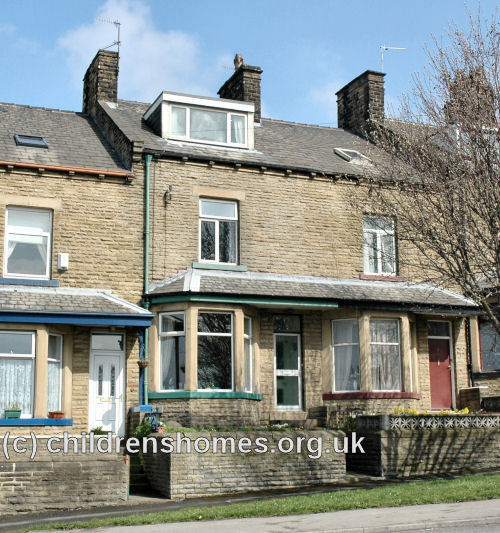
Former scattered home, 86 Lister Avenue, Bradford. © Peter Higginbotham
Following the passing of the 1948 Children Act, councils were required to provide care services for all needy children in their area, especially those who lacked a normal family home. In common with other local authorities, the council established a new Children's Committee, whose responsibilities had previously been spread across separate Health, Education and Social Welfare Committees. Under the new regime, residential care was seen as the least desirable option for children in care, but when it was employed, the recommended size of home was eight children, or twelve at most. Since Bradford's large collection of scattered homes largely fell within these guidelines, the council continued to use many of its existing properties. The stock was also added to by a number of similar properties and several larger houses.
A rare new-build development, opened in around 1945, was Springfield, a group of four cottage home style houses plus a reception and observation centre, located at the south side of Duckworth Lane, opposite Bradford Royal Infirmary.
Like many other councils at this period, Bradford provided residential nursery accommodation. By 1952, this included the High Park Nursery, Haworth Road, and the Moorville Nursery, Killinghall Road.
In addition to its children's homes, the Children's Department also had responsibility for the Moorland House Approved School at Ilkley.
The children's establishments in operation in 1969 are listed below. Those marked with an asterisk are premises inherited from the workhouse authorities.
| Central Home and Hostel, 93 Park Road* |
| 22 Ellercroft Terrace* |
| 385 Killinghall Road* |
| 4 Lapage Street* |
| 86 Lister Avenue* |
| 52 Rugby Place* |
| 15 Farcliffe Place* |
| 13 St Leonard's Road* |
| 15 St Margaret's Terrace* |
| Cavendish House, Idle* |
| Ashcroft, 440 Killinghall Road |
| 489 Barkerend Road |
| 20 Bell Dean Road |
| 20 Ellercroft Terrace |
| 85 Halesworth Crescent, Holmewood |
| 2A Hall Road Road |
| Hazel Hurst, Leeds Road |
| High Park Nursery, Haworth Road |
| 56 St Leonard's Road |
| 151 Kensington Street |
| 11 Makin Street (now Moorcroft Drive) |
| 26 Mayfield Terrace, Clayton |
| Moorville, Killinghall Road |
| 2 Northfield Road |
| 51 Old Park Road |
| 48 Saxton Avenue |
| 29 Woodroyd Terrace |
| Reception/Observation Centre, Springfield, Duckworth Lane |
| 2-5 Springfield, Squire Lane |
| Moorland House Approved School, Westwood Drive |